



The way people search for information online is changing quickly. In the past, most people used Google to find websites, compare products, and read articles. Today, many users also rely on AI-powered tools to get direct answers to their questions.
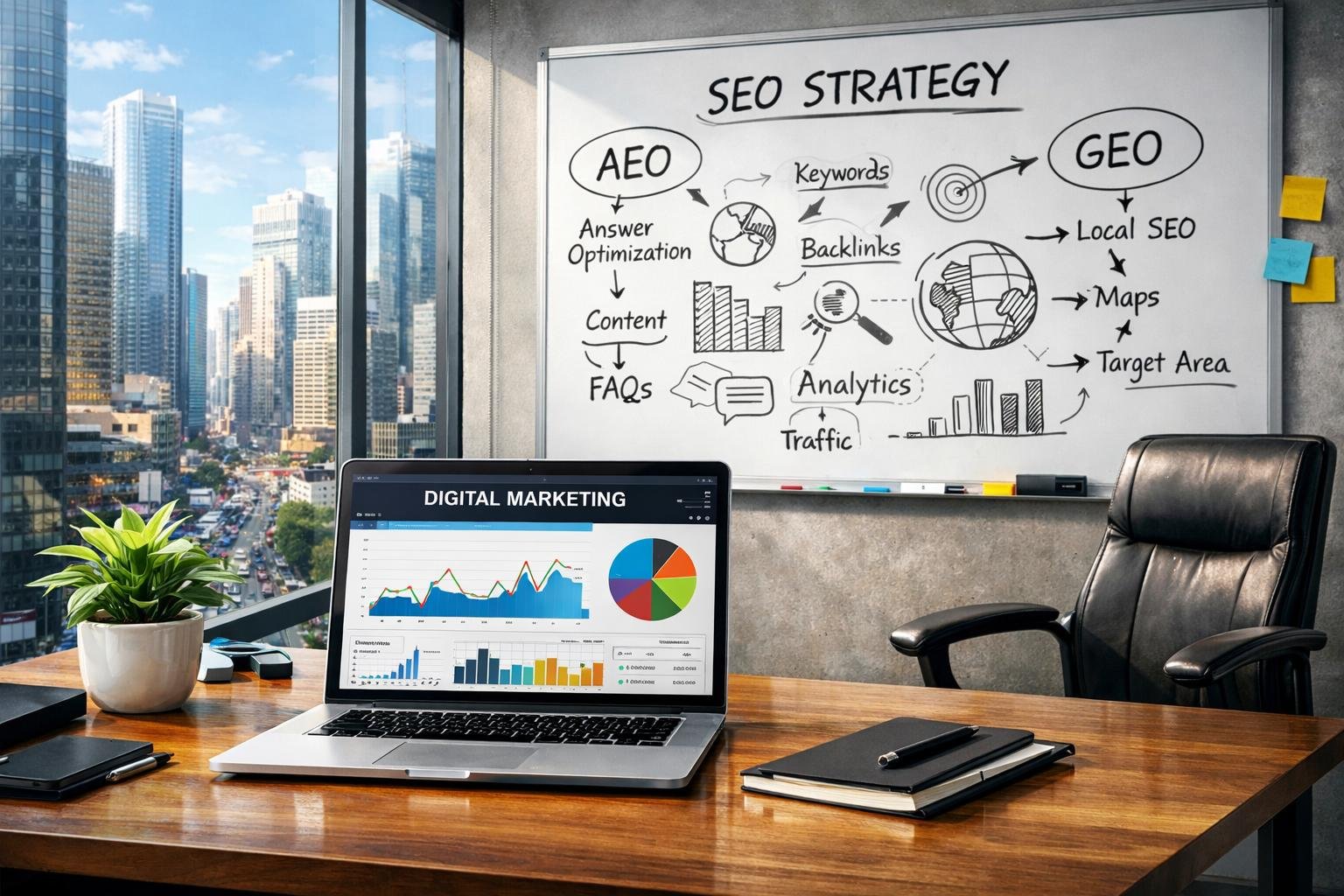
This change has introduced new terms in digital marketing, including SEO, AEO, and GEO. Although these three approaches have different focuses, they share a common goal: helping people discover useful information online.
For businesses, bloggers, and website owners, understanding these concepts can help them build a better online presence. But what do SEO, AEO, and GEO actually mean, and how are they different?
Let’s explore each approach in simple terms.
What Is SEO (Search Engine Optimization)?
Search Engine Optimization, or SEO, is the process of improving a website so that its pages can appear more prominently in search engine results.
For example, imagine someone searches Google for “best digital marketing agency for small businesses.” SEO helps an agency improve its website and content so that its relevant pages have a better chance of appearing in those results.
SEO involves several activities, including keyword research, content optimization, technical improvements, internal linking, and earning quality backlinks. Website owners can follow Google’s SEO Starter Guide to understand the fundamentals of making their websites easier for search engines to understand and users to discover.
The main goal is to make a website more accessible, relevant, and useful to both search engines and visitors.
Why Is SEO Important?
SEO helps businesses reach people who are already searching for information, products, or services related to what they offer.
A well-optimized website may attract organic traffic without requiring the business to pay for every click. SEO can also support brand awareness, customer trust, and long-term website growth.
However, SEO takes time, and rankings are never guaranteed. Results depend on many factors, including competition, content quality, and website performance.
What Is AEO (Answer Engine Optimization)?
Answer Engine Optimization, commonly known as AEO, focuses on making content easy for answer-oriented systems to understand and use when responding to questions.
These systems may include featured snippets, voice assistants, and AI-powered answer experiences.
For example, someone might ask, “What is technical SEO?” A clearly written article that provides a direct definition followed by a useful explanation may be well suited to answer-focused search experiences.
AEO encourages businesses to answer common questions clearly, organize information logically, and provide accurate, relevant details.
Why Is AEO Important?
Many users want quick answers rather than spending time searching through multiple pages. AEO helps businesses structure their content around these needs.
Useful AEO practices include adding question-based headings, writing concise answers, using descriptive subheadings, and supporting claims with reliable information.
For instance, a website selling home appliances could publish a guide answering questions about energy-efficient refrigerators, maintenance, and product features.
AEO does not guarantee that a search engine or AI tool will select the content. It simply helps make the information clearer and more useful for answer-driven experiences.
What Is GEO (Generative Engine Optimization)?
Generative Engine Optimization, or GEO, focuses on improving the chances that content will be discovered, referenced, cited, or mentioned in AI-generated responses.
AI-powered tools can combine information from different sources to create an answer. Depending on the platform and query, users may receive a summary rather than a traditional list of website links.
For example, someone might ask an AI tool, “How can a small business improve its online visibility?” The response may discuss SEO, content marketing, local search, and social media.
A business that publishes accurate, helpful, and well-organized information about these subjects may have an opportunity to be referenced as a source.
Why Is GEO Important?
As AI-powered search experiences develop, businesses are exploring ways to make their expertise visible beyond traditional search results.
GEO encourages website owners to publish original information, demonstrate real experience, explain topics clearly, and support factual claims with trustworthy sources.
It can also involve monitoring brand mentions, reviewing referrals from AI platforms, and understanding how a business appears in relevant AI-generated answers.
There is no guaranteed GEO formula, and different platforms may use different methods to select and present information. The most reliable starting point is to create content that genuinely helps readers.
GEO vs. AEO vs. SEO: Key Differences
Although these approaches overlap, each emphasizes a different aspect of online visibility.
| Feature | SEO | AEO | GEO |
| Main focus | Search engine visibility | Providing clear answers | Visibility in AI-generated responses |
| Typical environments | Traditional search results | Featured snippets, voice assistants, answer tools | Generative AI and AI-powered search |
| Content approach | Relevant, useful, search-focused content | Direct answers to specific questions | Clear, trustworthy, context-rich information |
| Common techniques | Keyword research, technical SEO, internal links | Question-based headings, concise answers, structured content | Original insights, credible sources, clear context, brand authority |
| Potential outcome | Organic search traffic | Greater visibility in answer-based results | Citations, mentions, or referrals from AI tools |
These are practical distinctions rather than strict boundaries. Search engines and AI systems overlap in how they discover, interpret, and present information. The same content can support all three approaches.
Can SEO, AEO, and GEO Work Together?
Yes. In fact, combining them is often more practical than treating them as completely separate strategies.
Imagine that you own a website offering digital marketing services. You want potential customers to find your website through Google and AI-powered tools.
You could start with SEO by researching relevant keywords, optimizing service pages, improving website speed, and creating useful blog posts.
Next, you could apply AEO by answering common questions directly. A blog about local SEO, for example, could include clear answers to questions such as “What is local SEO?” and “How does Google Business Profile help a business?”
Finally, you could apply GEO principles by adding original examples, including reliable references, explaining concepts in context, and demonstrating practical expertise.
Together, these activities create a stronger content strategy. They help users find information through different discovery methods while keeping the focus on usefulness and accuracy.
Best Practices for Improving Visibility Across All Three
You do not need three completely different strategies to get started. Many effective practices support SEO, AEO, and GEO at the same time.
1. Understand your audience. Research the questions your customers ask, the problems they face, and the information they need before making a decision.
2. Create helpful content. Write for people first. Avoid repeating keywords unnecessarily or publishing articles that provide little value.
3. Organize information clearly. Use descriptive headings, short paragraphs, relevant examples, and logical sections. Answer the main question early in the article.
4. Maintain good technical SEO. Make sure important pages are accessible to relevant crawlers, mobile-friendly, secure, and easy to navigate.
5. Demonstrate credibility. Use accurate information, genuine experience, appropriate author details, and reliable references. Update content when important facts change.
6. Measure performance. Monitor organic traffic, rankings, conversions, relevant AI referrals, and brand visibility where practical. Use the available data to improve your strategy over time.
Remember that structured data, backlinks, and other optimization techniques can support discoverability, but none guarantees selection or citation in an AI-generated answer.
Conclusion
SEO, AEO, and GEO represent different but related ways of helping people discover information online.
SEO focuses on improving visibility in search engines. AEO emphasizes providing clear answers to specific questions. GEO focuses on making useful information more likely to be discovered and referenced in generative AI experiences.
For most businesses, the best approach is not to abandon traditional SEO and focus only on AI. Instead, build a strong SEO foundation, answer customer questions clearly, and create credible content that offers genuine value.
As search technology continues to develop, businesses that understand their audience and consistently publish useful information will be better prepared to adapt to new ways of discovering content.


Leave a comment